Friday, April 15, 2011

Dyckman Farmhouse: Broadway at 204th Street

The Dyckman Farmhouse Museum was built in 1784 by one of the earliest Dutch farmers of New Amsterdam (now New York City), Jan Dyckman.  Jan's grandson, William, inherited the Dyckman land but during the British occupation fled upstate.  After the American Revolutionary War (1775-1783), William returned to find the family home destroyed but rebuilt the building that is currently the museum.

During the war, the British housed their hired Hessian (German) soldiers on the Dyckman farmland, and you can get a good sense of what that life was like through the reconstructed Hessian military hut (there were more than 60 on the farmlands) in the garden (see left).  Needless to say, it was a very austere life in cramped quarters (makes you appreciate the small space you may be living in if you live in the City).

The Dyckman Farmhouse itself was also very small.  With a few of rooms redecorated to their 1815-20 state (when the farmhouse was donated to the City as a museum), the nicely but sparsely decorated main and second floors were like some of the other historical homes I've recently toured (see my blog on the Merchant's House).  The parlor on the main floor was multifunctional for dining, sewing, writing, etcetera (see right).  The second floor bedrooms were plain and had to sleep up to 9 household members.

Unfortunately, the house is small and the half acre garden feels even smaller (see left, view from back patio), especially when one considers the 250 acres that once was a part of this farm (one of the largest in northern Manhattan).  If you are going to take the time to visit this museum in this northern part of the City, I would highly recommend walking the few blocks over to visit The Cloister Museum (my blog will continue next with my visit yesterday). The self-guided tour of the Dyckman Farmhouse is offered for mere $1 and if you have any questions, you can ask the volunteer who mans the museum Wed-Sat 11 am to 4 pm and Sun 12-4 pm (check www.dyckmanfarmhouse.org for current details). 

Sunday, April 10, 2011

Japan Society: E 47th Street btwn 2nd and 1st


The Japan Society is an organization dedicated to the enhanced international communication and sharing of the Japanese culture.  It was supported by John D. Rockefeller just a few years after WWII in an effort to improve tense relations between Japan and the United States.  Given my Korean background, I was a little wary of what I would find, but overall I was pleased and impressed with what I found there yesterday--during their all day Concert for Japan (f/k/a J-Cation).

Originally I believe the day was set aside as a kind of "open house" but after the tragic tsunami and earthquake that devastated (and continues to cause nuclear concerns), they blew out the events and included performances by numerous musicians starting at 11 am and going until 11 pm.

For a nominal fee of $5 per person (with a portion of the proceeds being set aside for the Japan Earthquake Relief Fund) folks got access to a healthy list of activities and entertainment.  I went mid-day (a little worried activities would be oversubscribed when I saw the long line outside the facility), and had an enriching day.

I first reserved a slot in a calligraphy workshop for about an hour and a half later.  Then I went upstairs where they were installing an interactive art lantern in honor of the victims of the Japanese earthquake.  Visitors were invited to fill out small paper wishes for the victims and add them to the art installation (see right).

Just next door was a gallery with modern Japanese art.  The various artists mixed traditional themes with images of modern life.  Makoto Aida's "War Picture Returns" contrasts with the propaganda that leading Japanese artists obediently create during the Korean War (see left and right).  He also portrays the effects of the battle for urban life with "Ash Color Mountains" in which he depicts an incredibly detailed pile up of gray-suited, conformist "salarymen" among broken technology waste (see top photo).

Overall I got the impression that many Japanese artists are incredibly detailed.  There were numerous pieces of grand wall-sized scale with incredibly tiny details -- so small that they provide magnifying glasses so that visitors can better appreciate the artistic finery (see left).  There was also an amazing cut paper piece by Tomoku Shioyosu called "Vortex" that was about 12' by 8' that was so finely cut that it looked like tissue-like organic cells.  Many of the artists also still seemed to struggle with Japan's past vis a vis the Korean War -- there were numerous references to Korea (as opposed to other countries) -- although notably at least one artists could still not turn his eyes inward toward his own country and instead chose to depict an abandoned Korean military installation and referred to past interrogations there.

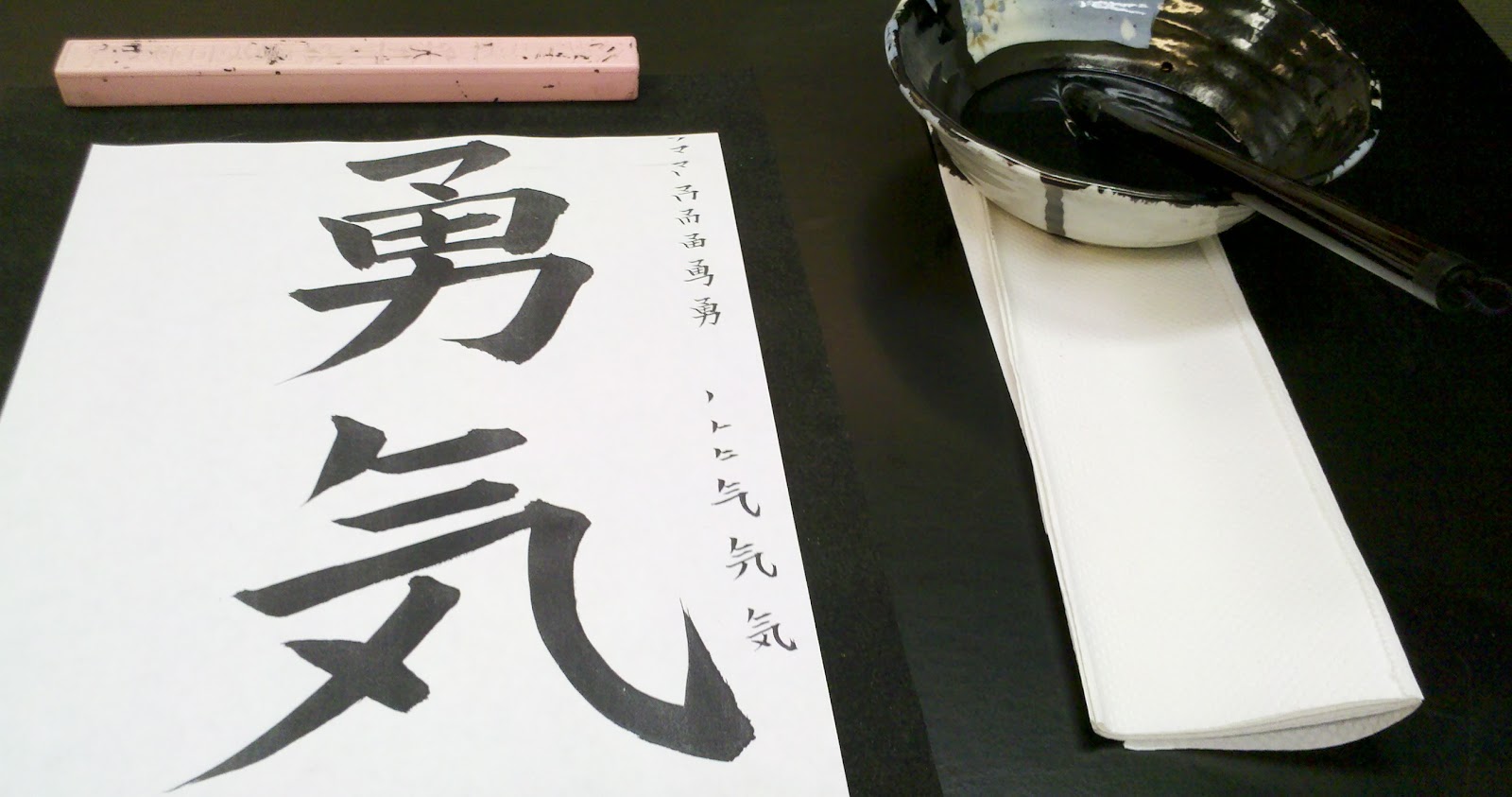
Obviously I spent a lot of time in the gallery, but I will say that the most enjoyable time I spent was in the 20 minute calligraphy workshop.  Attendees were taught basic principles and then given an opportunity to copy kanji characters with a calligraphy brush and black ink (see right).  It was great fun and I left feeling like I might want to take future courses at the Japan Society.  The instructor and helpers were very encouraging.

I also stopped by the origami workshop, which was casual and very approachable.  They had several instructors from the organization Origami USA (www.origami-usa.org) who were all patient and clearly wanted to share their love of origami.  They walked participants through step by step instructions on folding cranes, swans, flowers, cubes, etc. and also had a display of some very intricate origami examples (see left).  

Finally, I also enjoyed a couple of concert sessions in the remarkably well-appointed auditorium.  I particularly enjoyed the xylophonist (the "Flight of the Bumble Bee" was perfect and dramatic) and the traditional wind instrument player.  The more modern pieces by the pianist and the singer were not to my taste (see my blog about the NY Philharmonic) but for all of this included in the entrance fee, I thought this was the bargain of the month.

By the way, the Japan Society also rents out space for private events and their lovely, zen-like interiors could be just the right thing.  If you are in the UN neighborhood, I think their normal art exhibit would be worth a look.  And if you have any interest in learning Japanese (or if you are Japanese and have an interest in learning English), this seems like a great place to take classes.  All in all, this is a good resource for all things Japanese in NYC.

Friday, April 8, 2011

The Plaza Hotel: Central Park South and 5th Avenue

What a disappointment.  I was really hoping to get a tour of The Plaza Hotel, but was finally able to find out (after weeks of calling with no response) that they no longer give free tours.  I had read articles about what an amazing historical tour this was, filled with colorful stories from historian Francis Morrone.  The last article was published as recently as last October, but alas tours are now only available for groups (of up to 20) at a cost of $475.

Group tours are by appointment only--you are supposed to call The Boutique at 212.588.8012--but good luck getting a response.  Like I said, I called and left several messages but never got a call back until I emailed their press department.

If you want to get some background without having to gather a group and paying up, check out their website www.theplaza.com.  There is a video by Mr. Morrone on the site that is pretty good.

Anyway, I thought I would set the record straight on this tour.  It is really a shame, but I'd rather let folks know the truth rather than get frustrated like I was trying to reserve a spot on non-existent tours for weeks.  I hope they correct their website.

Sunday, March 27, 2011

NY Philharmonic: Lincoln Center


Last night I went to Lincoln Center (see above photo of The Metropolitan Opera House and below photo of the Revson Fountain and David H. Koch Theater) to enjoy a concert by the New York Philharmonic at Alice Tully Hall.


The concert was entitled "Hungarian Echoes IV" and included Haydn's Symphony No. 8, Bartok's Piano Concerto No. 1, Ligeti's Clocks and Clouds, and Bartok's Suite from The Miraculous Mandarin.  I was looking forward to the more traditional Haydn piece that was scheduled to open the concert.  It was melodic and beautiful to listen to, and the 21 minutes of the piece flew by.


The two Bartok pieces were a little more difficult to listen to, but they were dramatic and powerful.  The program explanations of the composer's life and the pieces themselves made the music more meaningful and appreciable as well.  The harmonic and alien sounds of the Ligeti piece made that piece interesting for me, but my brother had a laugh attack and had to apologize to his neighbors for his hysterical laughter.  I would have to agree that the Ligeti piece was foreign-sounding and a bit ridiculous (12 women singing unrecognizable sounds were the focus), but the program's background on Ligeti, including that Stanley Kubrick had used his music in his 1968 film "2001: Space Odyssey," had prepared me to be open minded to what was coming.

In any event, if you are not into avant garde music and are not certain of the music by their titles (like me), I would recommend that rather than purchasing tickets online, you may want to check with the sales person and call for tickets to make sure the performance you are considering is to your taste.  If you are frank with them, they can really be helpful in steering you to the right concert.  A good live orchestra concert can really move you; I've been brought to tears, overwhelmed by the beauty of certain orchestral pieces.

This past winter, I also attended "The Magic Flute" opera at the Metropolitan Opera House and a few years ago I attended a ballet at the Koch Theater.  Lincoln Center also has outdoor dance classes and dances in the summer and hosts the Big Apple Circus as well.  Right around the holidays, they also host the West Point or Canadian Brass Bands and have a fabulous holiday concert (although last year I preferred the holiday brass concert at the theater at The Metropolitan Museum).  There is something for everyone here, so if you are of the mind to "get a little culture" I would highly recommend checking out www.new.lincolncenter.org/live/.

I plan to take an art and architecture tour of Lincoln Center in the coming weeks. Stay tuned, and I'll report back on what I find.  I have high hopes!

Saturday, March 26, 2011

MoMA: 53rd Street btwn 5th and 6th Avenues

The Museum of Modern Art (MoMA) is a "staple" of New York City culture.  If you are a fan of contemporary or modern art, this is your mecca.  The MoMA has a fantastic collection of modern art in a manageable space, a good cafeteria, and an upscale restaurant (The Modern; (212) 333-1220).  Admission fees are pretty steep (adults: $20; seniors: $16; and students: $12) so if you don't mind crowds--which is almost always the case anyway--you may want to visit on Target Free Friday Nights every Friday 4-8 pm.

Currently, there are some notable exhibits that may be of interest.  The "Abstract Expressionist New York" is on view through April 25, 2011; "Counter Space," an exhibit about modern kitchen design is up through May 2, 2011 (see right); and "Picasso Guitars 1912-1914" (see left) is available through June 6, 2011.

Perhaps because recently I have failed miserably at keeping my own air plants alive, I thought the displays of Paula Hayes' terrariums in the main MoMA lobby of "Slug" and "Egg" (see right) was both beautiful and fascinating.  I hope visitors take the time to reflect on this little bit of peace, which is a "meditation on the fertility" of the Leopard Slug, in the hustle and bustle of the lobby.

Other "gifts" of the MoMA are the educational events that they host.  There are often kid-friendly films (free), brown bag lunches on various artistic topics ($5), and even lecture and studio courses (a couple hundred dollars for a series).  Check out the variety of learning opportunities at http://www.moma.org/learn/index. 

Finally, I feel the need to discuss the MoMA bookstore and gift shop.  This is not your ordinary shopping experience.  The items for sale fit the MoMA ideals of good design and are well curated.  It is not to say that all of these items are unique to the MoMA Store, but rather, that they have gathered fabulous inventory for sale.  I have successfully purchased gifts for the most difficult to please here.  Items are novel, interesting, and reasonably priced.  They range from books, housewares, clothing, furniture, toys, jewelry, and, of course, the requisite post cards, posters, and t-shirts.  This is a great resource for gift giving.

Thursday, March 24, 2011

US Customs House: One Bowling Green

The Alexander Hamilton U.S. Customs House is now the Smithsonian National Museum of the American Indian.  I'll first describe the history of the U.S. Customs House and then the Native American exhibits.  You can find out more information about the U.S. Customs House at http://www.oldnycustomhouse.gov/ and information about the museum at http://www.nmai.si.edu/.  I enjoyed my visit to this site for both the history and features of the building as well as the learning and meaning one can get from the collection exhibited inside.

The building is a great example of Beaux Arts architecture, designed by Cass Gilbert, and completed in 1907.  The building is so grand that it has had numerous cameos in movies, including "Ghost Busters II," "Working Girl," "Batman Forever," and "Analyze This." 

The seven story building (only the first 2 are open to the public) is adorned with stately columns and four large sculptures by Daniel Chester French (better known for the Lincoln Memorial in Washington D.C.) representing America, Asia, Europe and Africa.  The sculptures reflect the then-accepted stereotypes of each continent: America and Europe are shown as active, intelligent, capable and ruled by law (see America, above left).  Asia is passive, withdrawn and exotic, while Africa (see above right), leaning on a weathered sphinx, is actually asleep!

The building's interior is beautiful, with its curved stairwells, marble inlays, elliptical rotunda with 140 ton skylight, and murals by Reginald Marsh (whose work can also be seen in the Whitney Museum, the MOMA, and the Post Office Administration Building in Washington D.C.), depicting the "life of a ship entering NYC" (these murals were done as a commission, but with all the work that went into the difficult project, it is said that Marsh was paid a mere $0.90/hour).  The central desks from the time when this building functioned as a customs house remain, and there are numerous placards describing the history and restoration of the building that line the desks--definitely take the time to read these if you can.

The National Museum of the American Indian is very kid-friendly.  There are classes, story-telling, interactive displays (see right), and more (check out their website for events).  I was taken by the wonderful story of the raven who stole the stars, moon, and sun and the stunning glass work by the artist Preston Singletary currently exhibited through September 5, 2011. 

Also, the current exhibit featuring the Horse Nation is incredibly educational while being beautiful.  I learned that in the 1800s native trade routes were established and rates for horses (who were considered to be essential for life and like family pets--like dogs) were steep; for example, a race horse was worth 10 guns and a riding horse could be worth a gun and 100 rounds of ammunition.  The Apsaalooke (Crow) Nation from the Northern Plains of Montana (who rode in the inaugural parade for President Barack Obama) dressed their horses and used highly decorated equestrian equipment as they might adorn themselves (see horse installation above with items circa 1880-1890).   

The detailed bead work of the Inuit parka (c. 1890-1925) from Chesterfield Inlet in Canada (see right) and the Ktunaxa gauntlets from British Columbia, Canada made in 1890 out of deer hide, silk thread and cotton cloth (see below) are made to be not only be used but admired.  There was so much in the normal collection on view that I cannot possibly do it justice here, so I encourage anyone with an interest in beautiful, detailed handiwork to make there way to this museum.  Like the best things in life, visiting this museum is free!

Lastly, I want to make a pitch for the gift shop.  They have a good selection of Native American made jewelry and pottery that is both ethnic and modern.  I particularly liked the Acoma pottery--really beautiful and not too expensive given the quality and authenticity.

Wednesday, March 23, 2011

Fraunces Tavern Museum: Pearl and Broad Street

Long Room, where General George Washington Bid Farewell to his Officers at War's End
Back in the late 90s I worked just across the street from Fraunces Tavern.  I ordered dinner late at night from there often, but I am embarrassed to say that I never knew there was such a remarkable museum there.  I braved sleeting rain today to visit the museum, and was rewarded with an amazing step back in time on a self-guided tour.

The museum admission is $10 for adults $5 for seniors and students (for more detailed information on New York colonial history, current events, museum hours of operation, etcetera, please see http://www.frauncestavernmuseum.org/).  While the museum doesn't have all the bells and whistles of larger museums like the Natural History Museum or guided tours of federally funded historic sites like the Teddy Roosevelt birthplace (please see my prior post), the not for profit Sons of the Revolution have done an amazing job restoring this historic site and amassing a very respectable sizable collection of period furnishings, paintings, and artifacts.  See photos at left and below right of an early 1800s pistol and revolutionary period rifle, bullets, and trumpet.  

There is a very informative 15 minute video that tells the history of the site, first as the stately home of Oliver de Lancey, then as a tavern owned and operated by Samuel Fraunces (who also served George Washington as a spy and later as a member of Washington's house staff) -- when the site attracted all manner of business and revolutionary activity, and later as the site where the first Secretary of Foreign Affairs, Secretary of Treasury and Secretary of War operated.  It also relates the history and development of colonial New York and how Fraunces Tavern served a critical role at so many significant times.

It was at Fraunces Tavern that the Sons of Liberty met to plan before the American Revolution, where New York's first Governor George Clinton celebrated the British evacuation of New York, and where on December 4, 1783 in the Long Room (see first photo and photo at left) General George Washington met with all of his officers to say farewell after winning the war.

Thanks to the incredible foresight of the Sons of the Revolution, who in the late 1800s purchased the building and restored it to the way it was when George Washington often met at Fraunces Tavern, and the continuing work of the organization to collect period artifacts, this little museum is a real gem and definitely worth a visit for those interested in American history.