Showing posts with label gift shop. Show all posts

Saturday, July 16, 2011

New York Hall of Science (Queens): 111th St and 42nd Ave

If you have young kids, the New York Hall of Science in Queens is a fantastic place to visit with them. They have two floors and wide open outdoor space (not available in Manhattan) filled to the brim with fun interactive and educational things to do.  In addition to the almost innumerable interactive activities (some of which are listed below), there are also mini golf around a yard that includes space shuttle replicas! 

There are areas dedicated to illustrating natural networks, optical illusions, molecules, underwater life, sports physics (like reaction times for hitting the gas in a simulated auto race or the difference in bounce based on the firmness or softness of the floor/resistance -- see right), virtual arm wrestling, cow eye dissection demonstrations, rock climbing, tightrope walking (see below left), bungee jumping, a 4D simulator (like the ones at the Intrepid), scales that measures/estimates the amount of water or the number of molecules in your body, fun house mirrors, a pitching cage to show the difference in velocity when throwing different sized balls, and the list goes on and on.

It really is amazing how they thought of so many things to show and share.  I don't think I have ever seen such an aggregation of interactive educational things in my entire life.

The one thing I would caution if you are not coming as part of a school or camp group is that you may want to consider coming on a weekend when large groups may not be in attendance.  It is hard to control even a couple of youngsters so you can imagine what hoards of little ones might be like en masse.  I happened to visit on a weekday (mistakenly thinking that would be better than a weekend) and it was a bear trying to get around to see different things as children ran around in waves jumping in front of me at every turn.

In any event, if you get the chance to visit with a child (elementary school level would probably be best), it is certainly worth the $11 adult; $8 child cost of admission and it is conveniently located just 3 blocks from the #7 subway. Also make sure you leave a little time to check out the gift shop.  It has some unique geodes as well as some unusual gifts like astronaut ice cream -- much more unusual than the typical books and jewelry (which they have too).

Wednesday, June 29, 2011

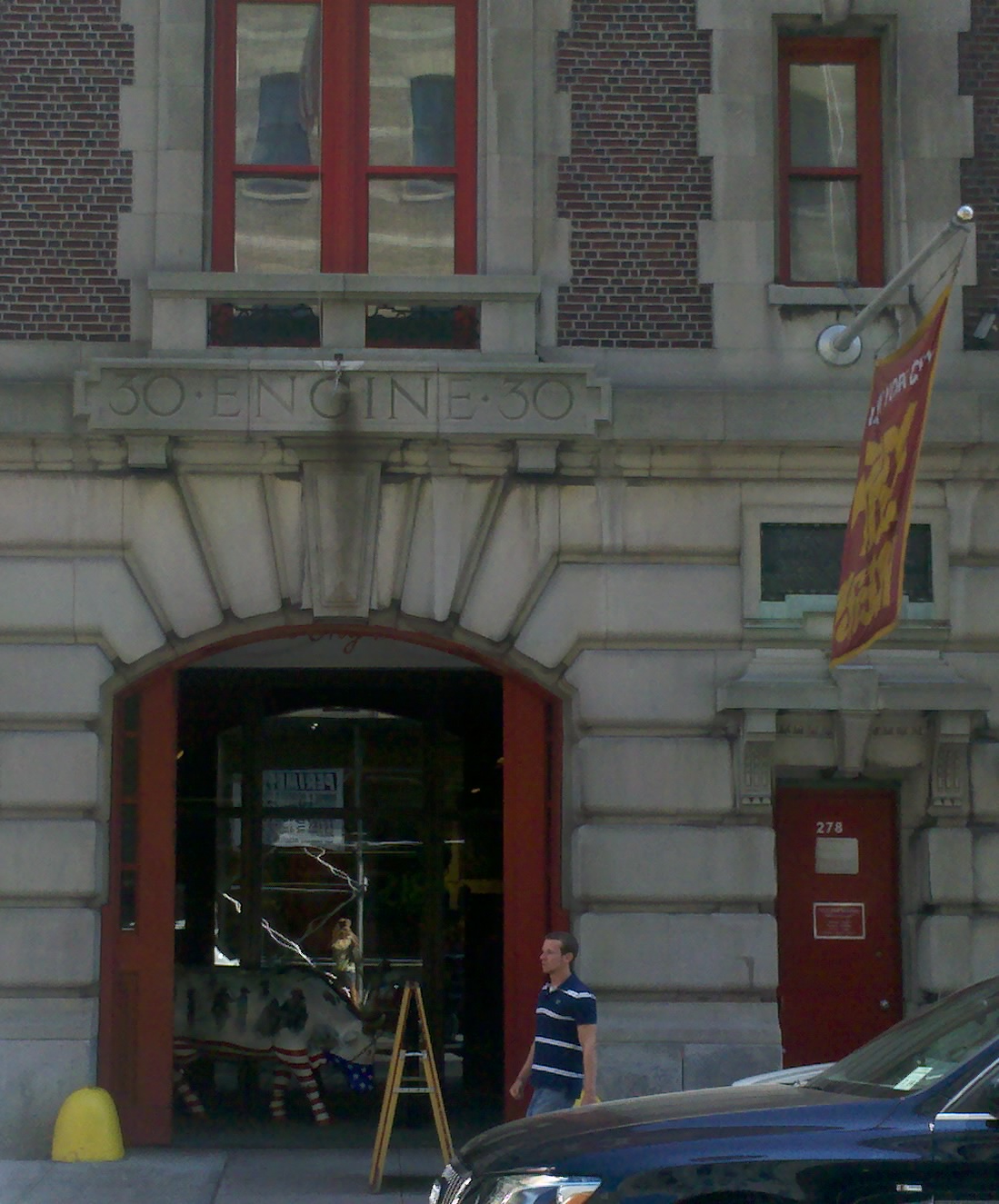
NYC Fire Museum: Spring St btwn Hudson and Varick Sts

As we approach another Fourth of July, I have been thinking about all the things made available and the costs incurred for freedom and independence.  We are not born into a caste (formal or informal) that we cannot rise above (or fall below).  We have the ability to make choices, have aspirations, and achieve goals (once we define or redefine them).  We have the right to voice our opinions and stand up for our beliefs (so long as they do not endanger others). 

There are clearly cons as well as pros, but overall I think most would agree we are incredibly fortunate (although there are often many obstacles) to have so many options.

Following my ruminations, I decided to visit the NYC Fire Museum in SoHo.  I wanted to see the old fire steam engines (see right), put on a fireman's uniform (which all visitors can do), admire the art and fire fighting memorabilia (did you know that fire bombs were initially used to fight fires? -- when they are thrown the explosion uses up all of the surrounding oxygen, thereby extinguishing fires), and most importantly pay my respects at the permanent 9/11 memorial exhibit (see left).

There are numerous fire trucks, beginning with hand pumped contraptions and horse drawn steam engines to more modern gas engined trucks and parade carriages (see right).  There are also stove top hats (originating in PA) and the earliest fire fighter hats with the wide back brim to shed water (originating in NY).  You can read about the history of volunteer fire fighting, the technological and equipment advances, as well as an early 1800s cholera scare that had people avoiding all water (getting wet was discouraged as was drinking cold water!).

As a dog fanatic, I was also particularly moved (and admittedly a little grossed out) by the stuffed dog in one display (see left).  This dog, named Chief, had rescued numerous people as well as a cat and kittens from various fires and on November 25th, 1936 was awarded Dog World's International Diploma of Honor.  There are also numerous pictures of various fire departments pictured with their dog mascots, who originally were fostered by fire houses to run alongside the horse-drawn fire trucks to keep stray dogs away from the horses.  At first, any dogs that found their way to a fire house welcome, but soon dalmatians began to become favored for their ability to run long distances without tiring alongside the horses.

This is a great little museum, and I would highly recommend a visit, especially if you are in the market for any FDNY paraphernalia or a little fireman's Halloween costume.  Check out their hours and admission prices at their website at Fire Museum.

Monday, June 27, 2011

Studio Museum in Harlem: 125th St by Seventh Ave

Yesterday was the last day of the latest exhibits at the Studio Museum in Harlem, and it was wonderful.  Not far from the Apollo Theater, this is an exhibition space that highlights contemporary African American artists and their work.

There were amazing collage pieces, modern art-cum-furnishings (see the grouping of "Man Made" chairs, lighting, totems, tables, mirrors, etc. by Stephen Burks at right made of Senegalese baskets, rope and plastics), as well as pieces an interesting exhibit of works by musician-artist Benjamin Patterson who even tried to record the movements of ants in song.

The museum also mixed in pieces from the its permanent collection by young artists like Adam Pendleton (who guided a tour I took at the Museo Del Barrio) who had a mural in the museum courtyard as well as a drawing hung just inside the museum lobby as part of a collections exhibit.

While you may have missed this show, don't be dismayed.  There will be a new exhibit up and running July 14th. The exhibit-to-come will again have temporary and permanent pieces mixed together, and looks like it will be another winner (Studio Museum Future Exhibits).
The two floor museum is well curated (well-presented and not too crowded) and it is a great way to spend about an hour on a Sunday (which are free thanks to support from Target).  Also be sure to pick up a free copy of the "Studio", which is the museum's seasonal magazine.  There is a great article about the latest winner of the Bravo show "Work of Art: The Next Great Artist," Abdi Farah (see photo at left of one of his finale winning pieces).

This is a great little museum definitely worth a visit if you are in the neighborhood.  They had the current curator of the Museum of Art and Design, MAD as their President and the legacy of this connection and professionalism shows.  Also, if you are a fan of Sheila Bridges' African-American toile (also displayed at MAD), you can get some bedding here at the museum gift shop.

Tuesday, June 14, 2011

Dahesh Museum of Art: CLOSED

It's interesting to me that NYC has 2 branches of the American Folk Art Museum (Folk Art Museum Main and Folk Art Museum Branch), filled with artwork by untrained artists, but it does not even have one museum dedicated to academically trained artists.

The Dahesh Museum of Art is the only institution in the United States devoted to collecting, exhibiting, and interpreting works by Europe's academically trained artists of the 19th and early 20th centuries, and it is closed.  Their gift shop is still open at 55 East 52nd Street (between Madison and Park) in the Atrium of Park Avenue Plaza and you can find store hours at Dahesh Museum Shop, but you can't admire what is supposed to be a beautiful collection of classical art there.

When I expressed interest in the museum at the shop, the salesperson gave me a pamphlet (see cover at left) that gave me a quick education about "academic art."  First established in Renaissance Italy, academies prescribed strict and rigorous guidelines for the production of works of art.  Organized training systems or academies in nearly every European country and then later in the U.S., Australia and Latin America set up a heirarchy for paintings by subject matter (e.g., religious and mythological ranking higher than landscapes and portraits) and raised art from a "craft."

The artists' handiwork should look effortless, without any visible brush strokes, to enhance the illusion of life-like exactness, the hallmark of academic art.  This smooth finish (also called "licked" finish or in French fini) contrasts with the contemporaneous artistic style of the now more popular and lauded 19th and 20th century Impressionists and Cubists.  After learning about the competitions to be chosen for years of academic training, so that an academic artist could show at salons at which they could hope to sell their art...well, wow.  I certainly have a new appreciation for academic artists (see the beautiful example of Adolph William Bouguereau's The Water Girl).  Their training sounds as strenuous and arduous as that of surgeons. 

The museum's collection was begun by writer and philosopher Salim Soussa Achi, aka Dr. Dahesh (1901-1984), who lived in Beiruit, Lebanon.  One day soon I hope the Dahesh Museum is able to find a suitable exhibition space and re-open to the public.  In this world of loose, free, and loud living (and with the immediate gratification of digital photos from every camera phone), perhaps academic art is out of style, but its discipline and beauty is also sorely lacking.

Saturday, June 11, 2011

American Folk Art Museum Branch: Columbus and 66th St

I recently went to the American Folk Art Museum's main location just next door to the MOMA, and learned that there was a branch location up by Lincoln Square.  The branch has different operating hours, so you may want to check their website (Folk Art Museum Info).  It is also much smaller in scale, but if you are in the neighborhood during open hours, it is definitely worth a look--besides, it's free!

The current exhibit focuses on the American Folk Art Museum's Year of the Quilt and has on display more examples of star quilts (see above), crazy quilts, patriotic quilts, and the list goes on and on. It also has a few other pieces that are made by untrained and talented artists (like the dress and head piece made out of paper copies of an American Folk Art painting at right).

And if you are interested in finding some novel, fun and quirky gifts, the gift shop here is great.  See for yourself.  Take a look.  You'll love it.

Tuesday, May 31, 2011

Wave Hill (Riverdale): 242nd Street & Independence Ave

Flower Garden
Do you believe in synchronicity?  A couple of weeks ago, I heard about Wave Hill from 3 different sources--in a card set that tells of 52 things to do in NYC which is sold at the MOMA gift/book shop, from my Citizen Pruner class instructor (see my prior blog), and then from a friend who was recommending I visit the gardens now that the weather is more consistently nice in NYC.  According to Deepak Chopra, synchronicity is a sign that one is on the right path so I made a plan to visit Wave Hill and today was the day.

I'll admit that this is not the easiest place to get to, but then again, many things that are worthwhile take a little effort.  Actually, taking Metro-North's Harlem line to Riverdale and taking the free shuttle bus was relatively easy, as I live close to Grand Central (I took the shuttle and the 1, A, B, and E subways to get home, but I thought I would try both ways so that I could let blog readers know the difference--it took 3 times as long and about half the non-peak price ($5.75)--it's definitely worth using the train if possible).  Also on Tuesday and Saturday mornings admission is free (check out their website for the latest if hours, tours, etc. at Wave Hill Info).

When I got to Wave Hill, I first went on a 45 minute tour at the Glyndor Gallery.  They are currently displaying the work of three artists, Philip Taaffee, Fred Tomaselli, and Terry Winters, who have been inspired by nature and created numerous pieces for the Glyndor Gallery.  Taaffee used screen printing, collage, and marbling washes to create layered pieces with direct references to sea life and indirect references to cacti.  Tomaselli layered collage from magazines and catalogs as well as resin and acrylic paint to create transformational and accessible psychedelic art pieces (see "Dahlia" above left and bird images created using outerwear clothing catalog images at right).  Winters does more abstract work that only references the balance of flowers in nature in his series of Hexagrams in oil, collage, and embossing.

View of Wild Garden from Beneath a Shady Trellis
Aquatic Garden
After the tour, I walked the main part of the grounds, particularly enjoying the Flower Garden (see top photo), the Wild Garden (see left), and the Aquatic Garden lined by trellis walkways (see below right).  Of course I also stopped by the Perkins Visitor Center and Gift Shop, where they had various appealing jams, chutneys, honeys, lotions, nature inspired jewelry and books.  By the way, if you are coming to spend a long time at the gardens, you may want to pack a snack, as they do not have much in the way of real food for sale.

But surrounded by all of this natural beauty, I was glad I brought a sketch pad and some pencils so that I could practice drawing and take down some of my impressions (not just by camera).  I sat at various Adirondack style chairs (they are littered around the garden) and stone benches in the shade of trees and trellises for about an hour and took in beautiful vistas and natural details.  It was a wonderful way to spend a sunny (and not yet too humid) afternoon.

I don't want to give people the wrong impression, this is not the size of the NY Botanical Garden or the Brooklyn Botanic Garden (see my prior posts on each of these).  In total, Wave Hill is about 28 acres and the conservatory (see photos below) are more like green houses.  However, if you want a less crowded, lovely garden filled with breathtaking views of the Hudson, this is a fantastic "hidden" spot in NYC.

Garden Chairs Planted with Succulents at the Conservatory Entrance

Cactus and Succulent House, Part of the Marco Polo Stufano Conservatory

Tropical House, Part of the Marco Polo Stufano Conservatory


Tuesday, May 24, 2011

Scandinavia House: Park Ave and 38th Street


I took a quick visit to the Scandinavia House to take a look at what they had to offer in this, the 100th anniversary of its incorporation.  I had lived just a block south of this place for several months when I first moved to NYC but had never gone in before.  On their main floor there is a good gift shop and a restaurant with a fantastically large "tree" in the middle of the dining area (see below).


On their third floor (the elevators are in the back just across from the main gift shop), there is a free exhibit, open Tuesday through Saturday from noon to 6 (see Scandinavia House for more info).  The current exhibit, called North by New York: New Nordic Art is a small overview of recent art from Denmark, Finland, Iceland, Norway, and Sweden. Curated by Robert Storr and Francesca Pietropaolo, the works - including painting, sculpture, photography, and video installations - draw attention to the diversity of contemporary Nordic artists.

Some of the art looks like it could have come from China and others are very political.  I particularly was transfixed by a video tracking the 99 year life of a woman.  I'm not sure why, but I was glued to the headset that told the summary life of a simple woman, just living (having children, getting ill, being there when her husband passes away, and then finally expiring herself).  I took a snap of the video (see right).

It is a small gallery space so really you can just stop by for about 15 minutes.  What a nice way to take a little respite from the hullabaloo of Park Avenue, Grand Central (just a few blocks north) and NYC in general.  Light and easy doses of modern art!

Thursday, April 28, 2011

Museum of Arts and Design: Columbus Circle

Bead Tapestry Made of Obama Campaign Poster Paper
This museum was once called the American Craft Museum but relocated and reopened as the Museum of Arts and Design (MAD) at Columbus Circle.  It's in a fantastic location, close to Central Park, the shopping at the Time Warner Center, and within a stones throw of Lincoln Center (see my prior post on Lincoln Center).  It is a great place to spend an hour discovering hand crafted contemporary and modern art from all around the world.  Admission is $15 for adults, and they have a pay-what-you-wish on Thursday evenings; check out their website MAD Info for current exhibitions, hours and admission.


I had been to this museum a couple of years ago when my husband and I saw what I thought was one of the best art exhibitions I'd ever seen (yes, my husband enjoyed it too).  I went back earlier this week to see their current exhibits, which included a lot of African and African-inspired art, ceramic jewelry, and American tapestries by Judy Chicago and Audrey Cowan.  Highlights for me include the Algernon Miller tapestry called "Change" made of beads made of rolled Obama campaign paper (see above), South African Heath Nash's modern and whimsical lighting made from plastic bottles (see right), and fanciful toile wall paper of African Americans (see below left) made by a Harlem artist, Sheila Bridges (I first saw this paper on the Nate Show's tour of Gayle King's kitchen).  They also have better known artists' work like Missoni and Keith Haring (one of his famous Apartheid lithographs).

The museum curates exhibits that go well with one another, with great lighting that makes viewing comfortable, and each floor's moderate footprint makes it possible to take in the art in manageable chunks.  It really is a lovely museum that one doesn't need to rush through.  Also, I would highly recommend reserving some time and energy for the gift shop.  They have jewelry, glass, fabric, and novelty items made by modern artists and artisans for sale--I couldn't help but buy a jewelry kit of hand made paper beads (a la Miller and the ladies of the Kwetu Afrika Womens Association Angels who made the recycled beads).  Hey, how can you beat $18 for modern art? 

My favorite piece in the gift store?  Well, you can't get more dramatic, delicate, and fanciful than Dutch-born, London based Tord Boontje's "Blossom" chandelier of Swarovski crystal (see right).  One day I'd love to have a house where something like this would work--in the meantime, I'll keep trudging through NYC.... 

Saturday, April 23, 2011

Asia Society: Park Avenue and 70th Street

The visit to the Asia Society was just about perfect.  Friday evenings after 6 are free (normally $10 for adults and $7 for seniors) and they provide a guided tour at 6:30.  I don't know if it was because this was a holiday weekend, but the museum was also relatively empty--with just those several people who were really interested in the exhibits.  I would highly recommend dropping by for an hour or so and taking the guided tour. Currently the museum is only exhibiting pieces on their 3rd floor and a small video exhibit on the main lobby floor.  Check the website also for other information such as coming exhibitions, films, and talks at Asia Society Info.

I am not very interested in manuscripts and the hand-drawn illuminations therein -- I recognize that this is a true art form but it is just not my taste.  However, the current exhibit of the 15th century manuscript called "A Prince's Manuscript Unbound: Muhammad Juki's Shahnamah" surprisingly piqued my interest.  This U.S. premiere of one of the finest surviving Persian manuscripts of all time includes over 30 gilded miniature paintings illustrating Persia's most famous folk tales and "super heroes."  There is kidnapping, rescue, battles, demons and more--all graphically shown, some in gruesome detail.  I tried the cell phone audio tour, which added some color, but I thought you could get more at your preferred pace by just reading the accompanying descriptions.


The other main exhibit is a portion of the museum's permanent ceramics collection, donated by John D. Rockefeller III (see example above).  The ceramics currently displayed are from China and include some of the finest imperial ware (versus commercial ware or export ware).  Here, the guided tour was really helpful.  Our guide really knew her stuff and shared her information graciously.  We went through the entire room and she pointed out the progression of ceramic advancements, how each emperor affected the ceramics of their time, and the beauty and details of each piece.  I don't think I would have appreciated this collection nearly as much if I had just walked through on my own.  This guided tour was fantastic.

There are also a few items on display on the lobby floor.  I particularly enjoyed a video of black and white hand-drawn animation.  Something about the little girl jumping and dancing around in her dreams was appealing.  Of course, the lobby also includes some more permanent, "serious" art like the Indian statue of Ganesha (see left), but even that piece has a little whimsy, don't you think?  There is something about the way six of the 10 hands are "dancing" that is joyful.

I really recommend a museum visit to anyone interested in Asian art.  You'll learn something (like I did about how art in the Middle East and China are related in style and by imperial blood) and hopefully like at least some of what you see.

Thursday, April 21, 2011

International Center of Photography: 6th Ave and 43rd St

The International Center of Photography (ICP) on Avenue of the Americas (6th Avenue) is part photography school, part research facility, and part museum.  I toured the museum on a whim (I was running late for an art and architecture tour at Lincoln Center (only given once a week) and traffic was against me), and was pleasantly surprised by the four current exhibits.

The museum's main level has the requisite gift shop and the lower level has a small cafe.  Both are good stops for a respite if one is experiencing museum fatigue.  I went through the museum on my own and made a point of reading most of the descriptions, as there were no audio tours available.  I also availed myself of the guided tour (3 pm daily) and while it was nice to have the interaction, I didn't gain much more from that than I did from the reading.

The current exhibit on the main floor is an extensive collection from what is known as The Mexican Suitcase.  That is not the most descriptive title, as the photographs really have little to do with Mexico. The negatives had been saved by the then Mexican ambassador to Spain in his luggage and was recovered in 2007 after the suitcase had passed through numerous unknown hands. The negatives and photos therefrom are from several Jewish photo journalists (Robert Capa, Gerda Taro, and David Seymour ("Chim")) who covered the Spanish Civil War (1936-1939).  The photographers tried to rally the international community with compelling, anti-fascist/Francisco Franco images (see right) and played a critical role in the war efforts.

**As a side note,Cornell Capa, who founded the ICP in 1974, was the younger brother of Robert Capa, and Cornell was fortunately able to see his brother's long lost work rediscovered before he passed in 2009.**

The first of the lower level exhibits is called "Jasper, Texas" and is a collection of community photographs taken by barber and professional commercial photographer Alonzo Jordan.  They show a proud and accomplished African-American community at landmark moments like graduation, purchasing new homes, and homecoming parades.  This is in stark contrast to what Jasper, Texas is now known for--the brutal racially motivated dragging murder of James Byrd, Jr. in 1998.

The next exhibit is a small collection of river baptism postcards (see left).  What was particularly interesting about this collection was not the actual photography.  That was rather poor.  However, they illustrated the scale of the events and were accompanied by correspondence both from the baptized and from Northerners who had purchased the postcards as examples of the spectacles they witnessed on vacations in the South.  These postcards actually captured more than baptisms; they caught a moment in American history (narrow-minded warts and all).

The last exhibit is a controversial commentary on Chinese consumerism.  This is painter-photographer, Wang Qingsong's first solo exhibition in the U.S., and I expect it will not be his last.  This artist sets up sound stages to exactingly execute images that relate his interpretation of China's intense collision with global consumer markets.  In "Requesting Buddha Series No. 1," the photographer created a self-portrait-Buddha with multiple arms reaching up and grasping numerous signs of commercialism: foreign beer, Chinese and American currency, Marlborough cigarettes, a cell phone, a roll of film, a compact disk and a tiny Chinese flag  (see right).  Other photos include murky public bath houses, rural migrant workers trying to enter Shanghai, and a re-interpretation of classical Chinese paintings with modern-day trappings.  All are grand-room-size in scale and are a bit surreal.  They certainly make you think.

In any case, if you are in the neighborhood and have a little free time (and $12 to spare for admission), I would suggest this is a better way to spend the day (or at least an hour) than just hanging out in Bryant Park (just a block away). Check out ICP Info for details on hours, current exhibits, and admission.

Saturday, March 26, 2011

MoMA: 53rd Street btwn 5th and 6th Avenues

The Museum of Modern Art (MoMA) is a "staple" of New York City culture.  If you are a fan of contemporary or modern art, this is your mecca.  The MoMA has a fantastic collection of modern art in a manageable space, a good cafeteria, and an upscale restaurant (The Modern; (212) 333-1220).  Admission fees are pretty steep (adults: $20; seniors: $16; and students: $12) so if you don't mind crowds--which is almost always the case anyway--you may want to visit on Target Free Friday Nights every Friday 4-8 pm.

Currently, there are some notable exhibits that may be of interest.  The "Abstract Expressionist New York" is on view through April 25, 2011; "Counter Space," an exhibit about modern kitchen design is up through May 2, 2011 (see right); and "Picasso Guitars 1912-1914" (see left) is available through June 6, 2011.

Perhaps because recently I have failed miserably at keeping my own air plants alive, I thought the displays of Paula Hayes' terrariums in the main MoMA lobby of "Slug" and "Egg" (see right) was both beautiful and fascinating.  I hope visitors take the time to reflect on this little bit of peace, which is a "meditation on the fertility" of the Leopard Slug, in the hustle and bustle of the lobby.

Other "gifts" of the MoMA are the educational events that they host.  There are often kid-friendly films (free), brown bag lunches on various artistic topics ($5), and even lecture and studio courses (a couple hundred dollars for a series).  Check out the variety of learning opportunities at http://www.moma.org/learn/index. 

Finally, I feel the need to discuss the MoMA bookstore and gift shop.  This is not your ordinary shopping experience.  The items for sale fit the MoMA ideals of good design and are well curated.  It is not to say that all of these items are unique to the MoMA Store, but rather, that they have gathered fabulous inventory for sale.  I have successfully purchased gifts for the most difficult to please here.  Items are novel, interesting, and reasonably priced.  They range from books, housewares, clothing, furniture, toys, jewelry, and, of course, the requisite post cards, posters, and t-shirts.  This is a great resource for gift giving.

Thursday, March 24, 2011

US Customs House: One Bowling Green

The Alexander Hamilton U.S. Customs House is now the Smithsonian National Museum of the American Indian.  I'll first describe the history of the U.S. Customs House and then the Native American exhibits.  You can find out more information about the U.S. Customs House at http://www.oldnycustomhouse.gov/ and information about the museum at http://www.nmai.si.edu/.  I enjoyed my visit to this site for both the history and features of the building as well as the learning and meaning one can get from the collection exhibited inside.

The building is a great example of Beaux Arts architecture, designed by Cass Gilbert, and completed in 1907.  The building is so grand that it has had numerous cameos in movies, including "Ghost Busters II," "Working Girl," "Batman Forever," and "Analyze This." 

The seven story building (only the first 2 are open to the public) is adorned with stately columns and four large sculptures by Daniel Chester French (better known for the Lincoln Memorial in Washington D.C.) representing America, Asia, Europe and Africa.  The sculptures reflect the then-accepted stereotypes of each continent: America and Europe are shown as active, intelligent, capable and ruled by law (see America, above left).  Asia is passive, withdrawn and exotic, while Africa (see above right), leaning on a weathered sphinx, is actually asleep!

The building's interior is beautiful, with its curved stairwells, marble inlays, elliptical rotunda with 140 ton skylight, and murals by Reginald Marsh (whose work can also be seen in the Whitney Museum, the MOMA, and the Post Office Administration Building in Washington D.C.), depicting the "life of a ship entering NYC" (these murals were done as a commission, but with all the work that went into the difficult project, it is said that Marsh was paid a mere $0.90/hour).  The central desks from the time when this building functioned as a customs house remain, and there are numerous placards describing the history and restoration of the building that line the desks--definitely take the time to read these if you can.

The National Museum of the American Indian is very kid-friendly.  There are classes, story-telling, interactive displays (see right), and more (check out their website for events).  I was taken by the wonderful story of the raven who stole the stars, moon, and sun and the stunning glass work by the artist Preston Singletary currently exhibited through September 5, 2011. 

Also, the current exhibit featuring the Horse Nation is incredibly educational while being beautiful.  I learned that in the 1800s native trade routes were established and rates for horses (who were considered to be essential for life and like family pets--like dogs) were steep; for example, a race horse was worth 10 guns and a riding horse could be worth a gun and 100 rounds of ammunition.  The Apsaalooke (Crow) Nation from the Northern Plains of Montana (who rode in the inaugural parade for President Barack Obama) dressed their horses and used highly decorated equestrian equipment as they might adorn themselves (see horse installation above with items circa 1880-1890).   

The detailed bead work of the Inuit parka (c. 1890-1925) from Chesterfield Inlet in Canada (see right) and the Ktunaxa gauntlets from British Columbia, Canada made in 1890 out of deer hide, silk thread and cotton cloth (see below) are made to be not only be used but admired.  There was so much in the normal collection on view that I cannot possibly do it justice here, so I encourage anyone with an interest in beautiful, detailed handiwork to make there way to this museum.  Like the best things in life, visiting this museum is free!

Lastly, I want to make a pitch for the gift shop.  They have a good selection of Native American made jewelry and pottery that is both ethnic and modern.  I particularly liked the Acoma pottery--really beautiful and not too expensive given the quality and authenticity.

Saturday, March 19, 2011

New Museum: Bowery and Prince Street

I went to the New Museum on Thursday night (admission is free from 7-9 pm weekly) with a friend, and we had a fun and enjoyable time.  It is a small museum with multiple floors (but almost all of it is elevator accessible) and is dedicated to modern art.

As you may know by now, while I can appreciate modern art, it is not my favorite.  The paintings and bronze sculptures of the current George Condo exhibit were fascinating.  He mixes cubist, mannerist, and cartoon-like styles in political and general life commentary.  Check out the exhibit at http://www.newmuseum.org/exhibitions/431/ to get a sense of the work.  I especially liked his take on real life people in his caricatures of Elliott Spitzer in the "Return of Client No. 9" and Queen Elizabeth in the "Insane Queen," and I could gaze forever at the painting that is somehow frenetic yet zen called "Internal Space."

There was also an exhibit of work by Lynda Benglis, who creates large scale foam, latex, found-object, and chicken-wire-based sculptures. I don't really get it, but perhaps if I had taken a guided tour it would have been better?  I doubt it.

If you have a fondness for modern art and have 30-45 minutes to spend in the lower east side, the New Museum could be just the ticket.  The gift shop also had a good collection of art books and some very witty t-shirts for sale.