Wednesday, April 27, 2011

Lincoln Center: 62nd and Columbus Ave

Metropolitan Opera House Lobby with "Space-Age" J&L Lobmeyr-Swarovski Chandelier
I've been to Lincoln Center for the Metropolitan Opera and the NY Philharmonic (see my prior blog post on the NY Philharmonic), but I had never been here for their guided tours until earlier this week.  They have numerous general tours and one or two art and architecture tours every week, and you can reserve a spot by checking the updated schedule (posted each Saturday) at Lincoln Center Tours and calling 212-875-5350. There are also behind the scenes, backstage tours of the Metropolitan Opera (3:30 weekdays and 10:30 and 1:30 on Sundays) available at Backstage Met Tours if opera is more to your taste.

Buy tickets and meet for the tour in the new David Rubenstein Atrium, located at 62nd and Columbus (just north of Dos Caminos).  It is a beautiful atrium public space with living walls (see photo at left), and you can get day-of  tickets for 25-50% off retail prices for Lincoln Center events there (check on Sat for Mon performances)!  With a 'witchcraft cafe, this is also a great place to grab lunch while you check emails on their free wifi.

I learned a lot of really interesting things about the recently renovated Alice Tully Hall, where they mostly have chamber music.  There is a portrait painting of Alice Tully with her favorite pooch in the lobby, and while the lady's accomplishments as a pilot in WWII were impressive, I was most taken with the story about how her dog peed on the painting to "christen" it for the Hall.  Less than 10' away from the main auditorium, the #1 subway rumbles more quietly past every few minutes due to the special riveting and felt-based sound barriers--it's actually the quietest part of the NYC subway system.  Inside, the auditorium has been fully lined by the wood of 1 special African tree that was thinly sliced into veneer in Japan and reinforced in Colorado. The way the wood lines the performance space is perfect for the acoustics required for chamber music.  However, if they have a vocal performance, they can lower fabric panels around the room to dampen the reverberation and make the space perfect for such performances.  All of this technology and the loving care brought to this place was cool to learn about, but I think I may be spending more time in their "at 65 Cafe" with its soaring all glass walls that make the space open and inviting.

We next walked back to the Avery Fisher Hall, home of the NY Philharmonic and once called Philharmonic Hall.  From the balcony level, we got a great view of the grand promenade level with its Richard Lippold's brass sculpture "Orpheus and Apollo."  I've gazed at this many times during intermissions, but never knew anything about the 5 ton, 190' long sculpture.  I always thought the 190 brass pieces suspended by steel cables were randomly placed bars (perhaps representing piano keys exploding?), but learned on the tour that they are actually very exacting placed, and each piece in Orpheus is mirrored in Apollo.  The sculpture isn't visible from the lobby, but you can enjoy it from the balcony and from outside (see right).

We crossed the courtyard and went to the David H. Koch (pronounced like Coke), home of the NY City Ballet and the NY City Opera.  The art in this building is really striking and you can get a great detailed look at Koch Art Tour.  My favorites are from the set designer Yasuhide Kobashi's 1972 "Ancient Song" (in the western staircase) and "Ancient Dance" (in the eastern staircase).  They look weighty and grand, but are actually light weight pieces from an opera set requested by Balanchine.  Others may make more of the Jasper John's "Numbers," which I will say I could also gaze at for days (looking for meaning in the key placed in one of the 8s and the footprint of dancer Merce Cunningham).  This was commissioned by the NYC Ballet and Opera for $12,000 and is now valued in the millions (they recently declined an offer for purchase).

Due to an opera performance taking place in the Metropolitan on the day of the tour, we couldn't go into the building, but how could I get this far without at least mentioning the amazing 30' x 36' Marc Chagall paintings, titled "The Triumph of Music" (see left) and "The Sources of Music" (right) (sorry for the glare)?  What is a bit alarming is that Peter Gelb, the GM of the Metropolitan has had to use these as collateral to continue to finance the Metropolitan, which apparently is running a $40 million/year deficit.  The endowment of about $300 million/year is down by about a third in this worrisome economy.  Yes, tickets to the Metropolitan can be steep, running up to about $400/pp but please know that there are standing room spots for as low as $75 on the main level and as low as $17 for balcony seats.  This is an unabashed call to support NYC opera--don't worry if you can't understand Italian, they have individual translator screens and, really, this is great theater.

Saturday, April 23, 2011

Asia Society: Park Avenue and 70th Street

The visit to the Asia Society was just about perfect.  Friday evenings after 6 are free (normally $10 for adults and $7 for seniors) and they provide a guided tour at 6:30.  I don't know if it was because this was a holiday weekend, but the museum was also relatively empty--with just those several people who were really interested in the exhibits.  I would highly recommend dropping by for an hour or so and taking the guided tour. Currently the museum is only exhibiting pieces on their 3rd floor and a small video exhibit on the main lobby floor.  Check the website also for other information such as coming exhibitions, films, and talks at Asia Society Info.

I am not very interested in manuscripts and the hand-drawn illuminations therein -- I recognize that this is a true art form but it is just not my taste.  However, the current exhibit of the 15th century manuscript called "A Prince's Manuscript Unbound: Muhammad Juki's Shahnamah" surprisingly piqued my interest.  This U.S. premiere of one of the finest surviving Persian manuscripts of all time includes over 30 gilded miniature paintings illustrating Persia's most famous folk tales and "super heroes."  There is kidnapping, rescue, battles, demons and more--all graphically shown, some in gruesome detail.  I tried the cell phone audio tour, which added some color, but I thought you could get more at your preferred pace by just reading the accompanying descriptions.


The other main exhibit is a portion of the museum's permanent ceramics collection, donated by John D. Rockefeller III (see example above).  The ceramics currently displayed are from China and include some of the finest imperial ware (versus commercial ware or export ware).  Here, the guided tour was really helpful.  Our guide really knew her stuff and shared her information graciously.  We went through the entire room and she pointed out the progression of ceramic advancements, how each emperor affected the ceramics of their time, and the beauty and details of each piece.  I don't think I would have appreciated this collection nearly as much if I had just walked through on my own.  This guided tour was fantastic.

There are also a few items on display on the lobby floor.  I particularly enjoyed a video of black and white hand-drawn animation.  Something about the little girl jumping and dancing around in her dreams was appealing.  Of course, the lobby also includes some more permanent, "serious" art like the Indian statue of Ganesha (see left), but even that piece has a little whimsy, don't you think?  There is something about the way six of the 10 hands are "dancing" that is joyful.

I really recommend a museum visit to anyone interested in Asian art.  You'll learn something (like I did about how art in the Middle East and China are related in style and by imperial blood) and hopefully like at least some of what you see.

Friday, April 22, 2011

Korea Society: 57th and 3rd Avenue, 8th Fl

I've lived in NYC for over 10 years and only recently I found out that there was a Korea Society here.  There is also a Korean Cultural Center (which I have not visited yet--their website was outdated which is not a good sign), and perhaps that diffusion of effort is why the Korea Society does not get the press it should--or perhaps it is because they have no street-level signage, being on the 8th floor of 950 Third Avenue.  Their little gallery is not really worth a separate visit (currently showing vintage commercial items from Korea), and it can be viewed before or after one of the numerous events that are very worth while.  Check out the website for a schedule of upcoming performances at Korea Society Info.

I attended a musical performance ($20/pp included light refreshments) entitled "Contemplative Traditions Music Series: Spring Court Music" last night that was educational, historical, and entertaining all at once.  Musician Heejung Han performed a traditional two-stringed instrument called the haegûm in the p’ungnyu style, which is supposed to be like musical poetry.

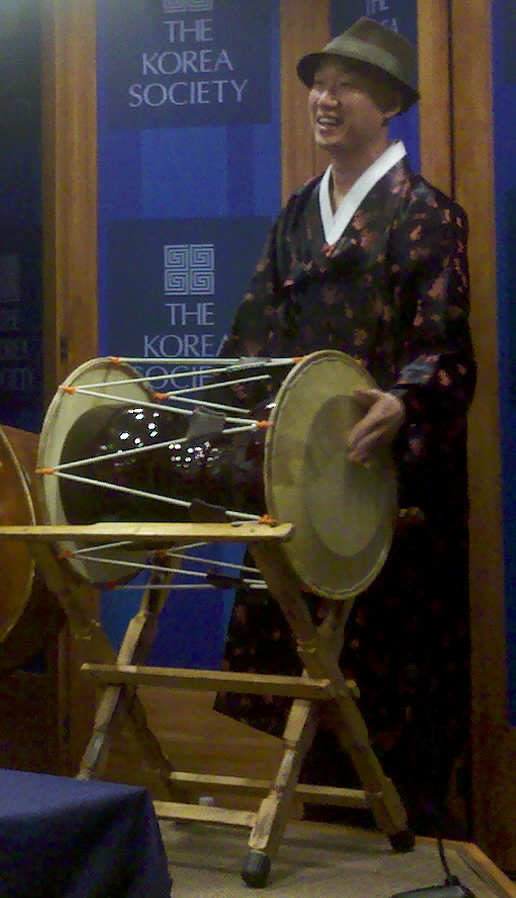
Her first piece called Yôngsan hoesang, was accompanied by a musician playing another historical instrument called the hyangp'iri (a kind of bamboo oboe) (see above left).  Her next piece was also traditional and played accompanied by a percussionist, Vongku Pak (see right), playing a traditional Korean drum called the changgu.  Finally, she concludes with a modern, jazzy Korean piece that includes an electric piano, a bass and the changgu but somehow highlights the unique sounds of the haegûm
(see below left).  My favorite piece was the last one; it was lyrical, playful, and just perfect to welcome spring.

After the performance, all the guests (of which there were about 100) were invited to continue taking refreshments and meet the artists.  It was relaxing, intimate, and the food was good too (traditional dduk (soft rice cakes) and boree cha (barley tea) was served along with fruit, cheese and crackers, and wine).

The only thing lacking from the evening was that the musicians did not engage with the audience.  It would have been great if they would have spoken a little about their instruments, the history of the traditional music, and the genesis of mix of old and new instruments in the last piece. I think that would have improved the audience's appreciation of the music, but it seemed to me that Ms. Han was shy (rarely looking up and never cracking a smile--unlike Mr. Pak who seemed to really enjoy the music -- see above).

I will be attending future performances, having joined the Korea Society as a new member.  It was definitely a bargain at $25, and I'm sure I'll be getting my membership's worth.

Thursday, April 21, 2011

International Center of Photography: 6th Ave and 43rd St

The International Center of Photography (ICP) on Avenue of the Americas (6th Avenue) is part photography school, part research facility, and part museum.  I toured the museum on a whim (I was running late for an art and architecture tour at Lincoln Center (only given once a week) and traffic was against me), and was pleasantly surprised by the four current exhibits.

The museum's main level has the requisite gift shop and the lower level has a small cafe.  Both are good stops for a respite if one is experiencing museum fatigue.  I went through the museum on my own and made a point of reading most of the descriptions, as there were no audio tours available.  I also availed myself of the guided tour (3 pm daily) and while it was nice to have the interaction, I didn't gain much more from that than I did from the reading.

The current exhibit on the main floor is an extensive collection from what is known as The Mexican Suitcase.  That is not the most descriptive title, as the photographs really have little to do with Mexico. The negatives had been saved by the then Mexican ambassador to Spain in his luggage and was recovered in 2007 after the suitcase had passed through numerous unknown hands. The negatives and photos therefrom are from several Jewish photo journalists (Robert Capa, Gerda Taro, and David Seymour ("Chim")) who covered the Spanish Civil War (1936-1939).  The photographers tried to rally the international community with compelling, anti-fascist/Francisco Franco images (see right) and played a critical role in the war efforts.

**As a side note,Cornell Capa, who founded the ICP in 1974, was the younger brother of Robert Capa, and Cornell was fortunately able to see his brother's long lost work rediscovered before he passed in 2009.**

The first of the lower level exhibits is called "Jasper, Texas" and is a collection of community photographs taken by barber and professional commercial photographer Alonzo Jordan.  They show a proud and accomplished African-American community at landmark moments like graduation, purchasing new homes, and homecoming parades.  This is in stark contrast to what Jasper, Texas is now known for--the brutal racially motivated dragging murder of James Byrd, Jr. in 1998.

The next exhibit is a small collection of river baptism postcards (see left).  What was particularly interesting about this collection was not the actual photography.  That was rather poor.  However, they illustrated the scale of the events and were accompanied by correspondence both from the baptized and from Northerners who had purchased the postcards as examples of the spectacles they witnessed on vacations in the South.  These postcards actually captured more than baptisms; they caught a moment in American history (narrow-minded warts and all).

The last exhibit is a controversial commentary on Chinese consumerism.  This is painter-photographer, Wang Qingsong's first solo exhibition in the U.S., and I expect it will not be his last.  This artist sets up sound stages to exactingly execute images that relate his interpretation of China's intense collision with global consumer markets.  In "Requesting Buddha Series No. 1," the photographer created a self-portrait-Buddha with multiple arms reaching up and grasping numerous signs of commercialism: foreign beer, Chinese and American currency, Marlborough cigarettes, a cell phone, a roll of film, a compact disk and a tiny Chinese flag  (see right).  Other photos include murky public bath houses, rural migrant workers trying to enter Shanghai, and a re-interpretation of classical Chinese paintings with modern-day trappings.  All are grand-room-size in scale and are a bit surreal.  They certainly make you think.

In any case, if you are in the neighborhood and have a little free time (and $12 to spare for admission), I would suggest this is a better way to spend the day (or at least an hour) than just hanging out in Bryant Park (just a block away). Check out ICP Info for details on hours, current exhibits, and admission.

Saturday, April 16, 2011

Whitney Museum: Madison Ave and 75th St

On this rainy Saturday, I spent a lovely afternoon visiting the Whitney Museum with a good friend.  We got to catch up, get a little culture, and then enjoy a great comforting lunch (Can you get more warm and inviting than grilled cheese sandwiches?  Don't dismiss this as mundane, executive chef Chris Bradley (formerly of Gramercy Tavern) has added sophistication by swapping the American for Gouda and adding extra topping options) at the museum restaurant, "Untitled." 

If you get to the museum before it opens, you will have to either wait outside (which may be okay on a sunny day but is definitely not on a rainy one) or HINT: go to the Untitled restaurant inside.  You don't have to pay for museum admission to dine there and the coffee from Stumptown Coffee and the pies from Four & Twenty Blackbirds Pies are fantastic. Besides, unlike most of the other museums near "Museum Mile," the Whitney is an unattractive dull grey building--so if you can avoid staring at that, why wouldn't you?

The Whitney Museum collection is modern American.  In the current exhibitions, there is a lot of art that has strong political messages and social commentary.  If this is not your normal bailiwick, I would highly recommend taking advantage of the free-with-admission audio guides.  The audio guides help make the more avant garde art accessible and understandable.  My friend and I both conceded that without the guides we would have missed some of the nuances and deeper meanings. 

I was particularly moved by the Glenn Ligon art inspired by children's coloring book drawings.  In this series Ligon was able to separate taught conceptions related to race and sexual identity from the innocent freedoms taken by children (see the Malcolm X silkscreen at right). 

I also came to appreciate the various pieces by Ed Ruscha, whose backgrounds with unrelated words was deftly explained in the audio guides.  For instance, I'm not sure I would not have figured out on my own that the "Lion in Oil" piece consisted of words forming a palindrome floating on a mountain formed by a Rorschach blot-like reverse image (see left).  The multi-level cleverness of pieces like this were interesting and fun to learn about.

If modern American art from the likes of Robert Mapplethorpe, Georgia O'Keefe, Willem de Kooning, and Andy Warhol get you going, the Whitney may be just the museum for you.  For the latest info on hours and admission, visit Whitney Visitor Info. Adult admission is $18; Student and Senior admission is $12. 

Please excuse the blurry pictures from the museum published exhibition calendar; photography is not permitted in the galleries.

NY Federal Reserve Bank: 33 Liberty btwn William and Pearl

Visiting the NY Federal Reserve Bank takes some advance planning (they do not take walk-ins), but it is well worth the free tour to get a peek into a cornerstone of our national monetary system.  To make reservations for your own visit, check out www.newyorkfed.org/aboutthefed/ny_tours.html and you should be able to find an opening about 3 weeks out.

The photo at left is the uninviting front entrance with original ironwork lanterns by Samuel Yellin. 

The tour includes a museum with an exhibit co-sponsored by the American Numismatic Society, and they put on display a collection of some of the most valuable coins and medals from around the world.  I'm not a coin collector, but I would think that for those who are, this is Mecca. The more than 800 examples from the Society's noted collection spans three millennia and includes a double eagle $20 coin that was last auctioned for over $7 million!


Just beyond the hallway (photo at right), which the Bank's architects York and Sawyer modeled after the the Strozzi Palace in Florence, Italy, you can learn about the central banking functions of the Federal Reserve System.  They have a hologram of a gold brick so that visitors can see the markings "up close."  They also have an interactive, multimedia exhibit called FedWorks, which allows visitors to participate in monetary policy quizes and to learn a little about the Fed's role in the economy.  I particularly liked the exhibit that tests visitors' ability to identify counterfeit bills.

After about 10 minutes in that exhibit, the tour moves on to a video of the cash processing system (NY's is now located in New Jersey).  This video explains how the NY Federal Reserve Bank is one of 12 regional federal reserve banks around the country that provide maintenance of currency, security and liquidity for the U.S. economy.

Finally, the tour is topped with a visit to the below ground and highly-secured gold vault (some 30 feet below the NY subway system) which has been in place since the early 1920s.  If you are a fan of gold, this is the part of the tour for you, but you may want to skip this if you are claustrophobic -- they simulate a closure which is pretty awesome.  Although no currency is currently backed by gold, the NY Federal Reserve (none of the other regional banks do this) holds gold for the U.S. (although most of the U.S.'s gold is held at Fort Knox), international organizations like the IMF, and foreign countries.  Today's tour was extra special in that there was some confidential transfer going on so there was a pallet laden with gold bars outside of the cages that normally would block such a clear viewing (there hasn't been a transfer in over 2 years). 

At the end of the tour, they led us back up to the locker level (no phones, cameras or purses are permitted) and gave us each a parting gift of real shredded money (they had explained earlier that bills that are worn are shredded routinely).

The tour was interesting, educational, and certainly something to add to the unique to NYC list. 

Friday, April 15, 2011

The Cloisters: Fort Tryon Park by Broadway and 190th Street

The Cloisters is a part of The Metropolitan Museum of Art but is located way way up on the upper west side (can you call this area the upper west side or is this the Bronx?).  It was one of the first contextual museums in the United States.  It is dedicated to the art and architecture of medieval Europe (500 to 1500 AD), covering both the earlier Romanesque period and the Gothic era.  It was never a monastery or a convent; it was originally built over 3 years and opened to the public in 1938 as a museum funded by John D. Rockefeller, Jr.

George Grey Barnard started collecting medieval art and architectural remnants (abandoned in the aftermath of the French Revolution) while he was living in France (trying to make a living when his commission for sculptures for the U.S. Capitol in 1902 was whittled back -- fall out of government corruption). After his return to the U.S. and after some financial hardships, he was forced to sell his collection at auction.  Rockefeller purchased the collection and later donated it to the Met.

The collection at the Cloisters is predominately religious in nature (not art that ranks high on my list of interests), and there are the beautiful, but predictable stained glass windows, religious paintings, religious sculptures, and religious objects (see detailed carving with over 90 figures in ivory cross at left), vessels and vestments.  Their collection also includes tapestries (you have to see the unicorn series in person to really appreciate their detail, beauty and symbolism) and sepulchers (see tomb effigy of boy (probably the Count of Urgell of Spain) at below right).


There was one tomb that we talked about in detail during the hour long guided tour of a knight -- definitely go on the tour (Tues-Sun at 3 pm, but check www.metmuseum.org for latest info on tours and lectures--by the way, notwithstanding what the website says, there are no shuttles between The Cloisters and The Metropolitan Museum of Art) if you want an interesting, interactive inside look.

However, what really makes this museum worth a good long visit (and their $20 for adults, $15 for seniors recommended donation--I didn't spring for the $7 audio tour and did not feel anything lacking given the free guided tour I took) are the cloisters, gardens and architectural mix of medieval and modern (see mid 12th century apse from the church of San Martin at Fuentiduena (Segovia) at left).  They have taken great care to combine real antiquities from all over Europe within a modern building in an integrated and almost seamless way. It's remarkable how they tied in the glass from one castle to the chapel of another married with the ceiling of another with doors (please take the time to notice the doors; you could walk right by them if you don't pay attention and their collection of medieval doors is worthy of a tour on their own) from yet another and make it look like it all belongs together.

For me, the highlight of the museum were the four cloisters.  The architecture that enabled monks to get from one part of a religious compound to another with protection from the weather form restful, garden-filled areas surrounded by arches of unique columns and capitals.  They are all beautiful, and when the garden tours start in May, I am sure the cloisters will be even more so.  I've included my version of artistic photos of each of the four cloisters below.  Enjoy!

St. Guilhelm Cloister which is fully enclosed by an atrium roof
Trie Cloister by which you can enjoy light dining from Cafe Trie
Bonnefort Cloister from the edge of which you can see scenic views of the Hudson River
Cuxa Cloister, which they have determined was double in size originally

Pontant Chapter House where monks would gather to conduct business at NW corner of Cuxa Cloister