Tuesday, June 7, 2011

Brooklyn Museum of Art: Eastern Parkway

So about 12 years ago I had won a free 1 year subscription to the Brooklyn Museum of Art and never bothered to even look it up.  Ok, so the internet was not as big and I was working so feverishly that I hardly had time to breathe let alone visit a museum, but still.... I have been wanting to correct this omission for a while now and I finally did last Sunday (they are closed on Mondays; see Brooklyn Museum Info).

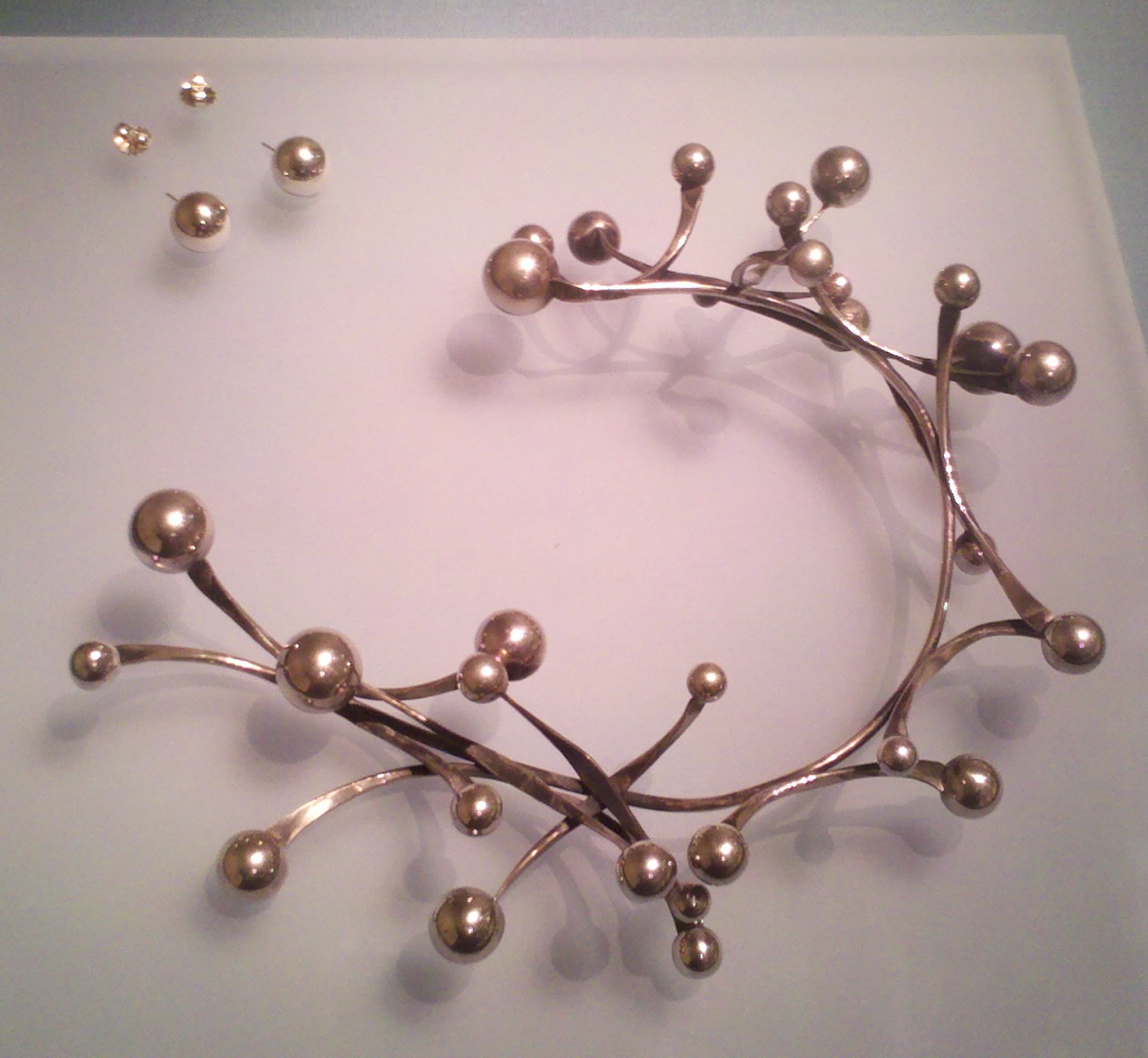
I was shocked to find that the Brooklyn Museum of Art is like the Metropolitan Museum in scope and perhaps even in scale (see photo at the top of the Greek revival and modern exterior) but with a quirky Brooklyn style and focus.  They have antiquities from Ancient Egypt (yes, even a coffin and mummy board) to modern jewelry makers like Brooklyn artist Art Smith (see "Galaxy earrings and necklace at right).

They have innumerable alcoves decorated with period (1600s-early 1900s) furnishings as well as a collage piece from 32 year old artist Rashaad Newsome called "Status Symbol #20 that is a commentary about American hunger for luxe consumer goods and celebrities like L.L.Cool J. (see photo at left of the "status coat of arms" that includes race cars, Rolex watches, and other jewelry).

You can be admiring the Museum's collection of paintings by Monet, Cezanne, Pissaro, Millet, Degas, Goya, Picasso, and Manet  or looking over their extensive African or East Asian art collections while listening to the samba music piped in through the speakers in the galleries.  It is great!

They have really interesting art by women artists, but they aren't "preachy"--how refreshing!  The Dinner Party by Judy Chicago is an icon of feminist art, which represents 1,038 women in history—39 women are represented by place settings (see Emily Dickenson's at right) and another 999 names are inscribed in the Heritage Floor on which the triangularly-arranged banquet table rests (see below).


Somehow, the Brooklyn Museum of Art manages to be a serious museum that doesn't take itself too seriously, and thereby they make the museum experience super enjoyable.  They are currently displaying some of their more classic paintings by theme (rather than by artist) and it is great to be able to compare portraiture, landscapes, and religious works this way.  Even though one of the five floors of the museum was closed for exhibition preparation, I thought the $10 fee was well worth it. 

You might consider making it a whole Brooklyn day by visiting the Brooklyn Museum of Art and the Brooklyn Botanic Garden (please see my prior blog at Brooklyn Botanic Garden Blog), which is right next door.  What a great day that would be!

Sunday, June 5, 2011

MTA Museum (Brooklyn): Boerum Pl. & Schermerhorn St.

You might think that the MTA Museum is for children, but you'd be wrong.  Yes, they do have over 19 vintage railway, trolley, bus, and subway cars to explore (see above), an interactive area devoted to educating about various power sources and pollution, storytelling events, and a luncheon area for children's birthday parties, but they have much much more.

There are interesting historical exhibits that describe the dangers and meager wages of the subway tunnel builders, the development of the trolley and subway systems, the evolution of the cash-token-metro card, and the pivotal role played by Robert Moses in the creation of the public mass transit system.  The 60,000 square foot museum also houses over 6,000 objects that illustrate the technological history of the NYC transit system.  Finally, they also have a summary exhibit of transit art; have you ever noticed the interesting little sculptures, mosaics (like the Roy Lichtenstein -- see left), or vintage tiles that adorn the walls of various subway stations (see Transit Art)?

I will share with you all what I found most interesting about the museum, although I doubt if the museum curators wanted this to be the focus.  Lining the walls of the perfectly preserved train cars in the lower level are vintage advertisements.  Many of the products are still available (like Heinz 57, Wrigley's Spearmint Gum, and Clairol hair color dye), but there are also really interesting period public announcements and advertisements for issues and products that we don't have anymore (shirt collar ads and announcements about tuberculosis -- see photo at left and below).  I loved looking through all of these advertisements and I hope visitors take the time to appreciate them.

If you ever find yourself in Brooklyn Heights or before you take the free shuttle to the Brooklyn Ikea from Borough Hall in Brooklyn, you may want to walk a few blocks and stop by the MTA Museum headquartered in the decommissioned but still operational subway station that functions as the museum's main location (the annex is located at Grand Central -- please see my prior blog about Grand Central).  In about an hour, you can take a tour (check hours and admission info at MTA Museum Info) and enjoy learning about the MTA and how it has completely transformed and enabled the development of NYC into the powerhouse for power players that it has become.

Saturday, June 4, 2011

Neue Galerie: 86th Street and Fifth Avenue

The Neue Galerie (Neue Info) is a museum dedicated to German and Austrian Art.  On the first Friday of each month, it is free from 6-8 pm (normally $15/adult; $10/students and seniors, children not admitted) and apparently New Yorkers are drawn to this museum on such evenings in hoards.  I got there a little after 6:30 pm and there was an hour-long line just to get inside!  And once inside, it was shoulder-to-shoulder--ugh. 

While not the most relaxing way to spend an evening, if you are hungry for some modernist German or Austrian art, there is probably no place better in New York City.  The museum's 2 floors of galleries currently show modern paintings, drawings, clothing, furniture, jewelry, home goods, and architectural models.  With about 30-40 minutes, one can dwell on favorite pieces, get a detailed look at the clean plain styles of Adolf Loos, as well as the colorful precursors to art deco style from Josef Hoffman. 

Given my recent study of German Expressionists at the MOMA (please see my prior blog on MOMA Courses), I was particularly drawn to the paintings by Gustav Klimt and was pleased I recognized the flattening of the subjects with the backgrounds and the play of positive and negative spaces (see photos). 

I don't think I will repeat my visit any time soon (too crowded on free nights and not worth the $15 for such a small collection), but I am glad I visited it at least once.  If I have the time and want an infusion of art, I would rather revisit the Hispanic Society of America (please see my prior blog), which is always free and has just as impressive (if not more so) a collection of Spanish and Latin American art.

Friday, June 3, 2011

The Hispanic Society of America: Broadway and 156th St

Statuary in Audubon Terrace in front of the Society with iconic equestrian statue of El Cid
by American sculptor, Anna Hyatt Huntington
 WHAT A HIDDEN JEWEL!

The Hispanic Society of America has an amazing collection of tin-glazed earthenware, tiles, and ceramics ranging from 3000 year old Bell-Beaker pottery to contemporary works.  Their 150 piece Spanish luster-ware collection is considered the finest in the U.S. (see right--ok, the plate I chose to feature was one that I was personally drawn to because originally I thought the dog pictured was a poodle, like my beloved Biscuit, but I think, given that this is the Hispanic Society (and not the French one), it is probably a Portuguese Waterdog)  Other decorative arts include silver, glasswear, ivory-detailed furniture, silks and embroidery, and jewelry.


If your interests lie in sculpture or archeology, the Society's collection of Spanish antiquities, which is considered the most important outside of Spain is simply amazing.  There are Roman mosaics, statuary, Islamic and Christian works from the Middle Ages.  What sets the Society's display apart from others (like the fantastic one at The Cloisters -- see my prior blog), is that visitors can really get up close and personal with the pieces (see detail in an architectural remnant at left). 

Actually, I think that they receive such few visitors -- I was the only visitor there for over an hour! -- that the guards don't really do much of anything.  Please give these guys something to do and visit this magnificent art collection; it's always FREE!

But really, the crown jewel of the Society's collection are its paintings.  They have original paintings by, among others, Diego Velazquez, Francisco de Goya, Domenikos Theotokopoulos (El Greco -- see right), and Joaquin Sorolla y Bastida.

The Sorolla paintings are my absolute favorite--it reminds me of the Sorolla Museum (which was once the painter's home) where I spent countless afternoons when I lived in Madrid during my junior year in college.  The way Sorolla captures water and sunlight on skin in summer time beach scenes is something that I have never forgotten and believe no one can match (see left and right--yes, I know these pictures are terrible, but hopefully that will encourage you to come see them for yourself).


The Sorolla Room's breathtaking panoramic series of 14 canvases illustrating life in Spain in the early 1900s is a beautiful way for the Society to share with visitors a celebration of Spanish culture, costumes, and pastoral life.  I have included some pictures below, but really they do not do the paintings justice and you should really visit the galleries here (Hispanic Society Info).


I can't emphasize this enough.  After several months of exploring NYC I think this place is really one of the best kept secrets and hidden jewels of the City.  Please visit The Hispanic Society of America.  You'll be abundantly rewarded for the effort of coming all the way up to 156th Street.

American Academy of Arts & Letters: 156th and Broadway

"Texas Swing" by Malcolm Morley.  Oil on linen, 80.5" x 120"
The American Academy of Arts and Letters is an institution that strives to recognize and award emerging artists--painters, sculptors, architects, composers, and writers.  It clearly doesn't get the pomp and circumstance that the Oscars or the Emmys generates, but if you have an interest in any of the represented arts and are lucky enough to have time in NYC when they are exhibiting winning pieces (twice a year; the current show goes from May 18 to June 12 -- check out their website for the latest: http://www.artsandletters.org/), you should definitely take a look.  You could have a very personalized and serene experience (I was the only one visiting during the forty-five minutes I was there).
"Years Later" by Amy Bennett. Monotype: oil on paper, 18" x 22.5" framed
I particularly liked the fact that Academy members were the ones who were manning the 4 galleries.  These "security guards" are actually artists and obviously have a real interest in the art and exhibition space.  They are more than willing to share their insights, thoughts, etc. and that is a real treat.

Architectural Presentation Model by Robert A. M. Stern
I particularly liked a few of the paintings (see first two photos above) that caught real life details and light in an almost surreal way.  I was fascinated by the architectural models (see above), especially the Disney casting center and feature animation buildings as well as the deconstructed Mickey Mouse seating (perhaps once a cast member, always a cast member? -- I once worked for the Mouse).  Also, there were several cabinets filled with recently published books displayed with manuscript pages (see below); it got me thinking about the process of writing, publishing and possibilities....

A well-timed visit to the American Academy of Arts and Letters can be an inspiration to the opened heart and mind.

Thursday, June 2, 2011

Museum of the City of NY: 103rd and Fifth Ave

With all the hoopla surrounding the major museums in NYC (the MOMA, the Met, the Natural History, etc.), the smaller, more niche museums are often overlooked.  Did you even know there was a Museum of the City of New York?  I really didn't know what to expect (their website does not provide a great overview, but it does provide basics like hours and admission fees--Museum of the City of NY Info), but with about an hour, I got a good look into this rich museum.

About a third of the museum is closed for renovation, but what is open to the public, while a little disjointed (varying from a temporary photography exhibit called "Moveable Feast: Fresh Produce and the NYC Green Cart Program" to a time-line wall mural about "How the Apollo Theater Shaped American Entertainment"), is really worth a visit.


The museum also has vintage metal toys (see left), a wonderful collection of period furniture showcased in alcoves with distinct styles (including several Duncan Phyfe pieces) as part of its permanent exhibit of New York Interiors from 1690-1906, and the incredibly detailed Stettheimer Dollhouse with real miniature paintings like the Marcel Duchamp of "Nude Descending a Staircase" (see below left), and an interesting exhibit of memorabilia and NYC photographs from consummate NYC Tony Award winning performer Joel Grey.

However, I think one of the best highlights of this museum is the 23 minute film in the Timescapes viewing room about the history of New York City.  It weaves stories of immigrants, the development of communities like the Lower East Side, the Upper East Side, the Upper West Side, and Wall Street.

It also explains the effects of public transportation and the policies of Fiorella LaGuardia and Robert Moses that created commercial areas completely separate from suburban commuter communities and what that did to the City when the economy faltered.  Whole areas of New York City became a kind of urban wasteland and it was only when grass roots initiatives for revitalizing the City coupled with increased investment in infrastructure and safety in the 1970s turned the tides around.  By the year 2000 New York City was again the fastest growing city in the country.  If you have an interest in history, a visit to this museum is a must.

Finally, I should mention that if you have a wedding or formal event to plan, you may want to consider the Museum of the City of New York.  With its grand staircase and marble foyer, it could be just the location to make your next event extra special.

Tuesday, May 31, 2011

Wave Hill (Riverdale): 242nd Street & Independence Ave

Flower Garden
Do you believe in synchronicity?  A couple of weeks ago, I heard about Wave Hill from 3 different sources--in a card set that tells of 52 things to do in NYC which is sold at the MOMA gift/book shop, from my Citizen Pruner class instructor (see my prior blog), and then from a friend who was recommending I visit the gardens now that the weather is more consistently nice in NYC.  According to Deepak Chopra, synchronicity is a sign that one is on the right path so I made a plan to visit Wave Hill and today was the day.

I'll admit that this is not the easiest place to get to, but then again, many things that are worthwhile take a little effort.  Actually, taking Metro-North's Harlem line to Riverdale and taking the free shuttle bus was relatively easy, as I live close to Grand Central (I took the shuttle and the 1, A, B, and E subways to get home, but I thought I would try both ways so that I could let blog readers know the difference--it took 3 times as long and about half the non-peak price ($5.75)--it's definitely worth using the train if possible).  Also on Tuesday and Saturday mornings admission is free (check out their website for the latest if hours, tours, etc. at Wave Hill Info).

When I got to Wave Hill, I first went on a 45 minute tour at the Glyndor Gallery.  They are currently displaying the work of three artists, Philip Taaffee, Fred Tomaselli, and Terry Winters, who have been inspired by nature and created numerous pieces for the Glyndor Gallery.  Taaffee used screen printing, collage, and marbling washes to create layered pieces with direct references to sea life and indirect references to cacti.  Tomaselli layered collage from magazines and catalogs as well as resin and acrylic paint to create transformational and accessible psychedelic art pieces (see "Dahlia" above left and bird images created using outerwear clothing catalog images at right).  Winters does more abstract work that only references the balance of flowers in nature in his series of Hexagrams in oil, collage, and embossing.

View of Wild Garden from Beneath a Shady Trellis
Aquatic Garden
After the tour, I walked the main part of the grounds, particularly enjoying the Flower Garden (see top photo), the Wild Garden (see left), and the Aquatic Garden lined by trellis walkways (see below right).  Of course I also stopped by the Perkins Visitor Center and Gift Shop, where they had various appealing jams, chutneys, honeys, lotions, nature inspired jewelry and books.  By the way, if you are coming to spend a long time at the gardens, you may want to pack a snack, as they do not have much in the way of real food for sale.

But surrounded by all of this natural beauty, I was glad I brought a sketch pad and some pencils so that I could practice drawing and take down some of my impressions (not just by camera).  I sat at various Adirondack style chairs (they are littered around the garden) and stone benches in the shade of trees and trellises for about an hour and took in beautiful vistas and natural details.  It was a wonderful way to spend a sunny (and not yet too humid) afternoon.

I don't want to give people the wrong impression, this is not the size of the NY Botanical Garden or the Brooklyn Botanic Garden (see my prior posts on each of these).  In total, Wave Hill is about 28 acres and the conservatory (see photos below) are more like green houses.  However, if you want a less crowded, lovely garden filled with breathtaking views of the Hudson, this is a fantastic "hidden" spot in NYC.

Garden Chairs Planted with Succulents at the Conservatory Entrance

Cactus and Succulent House, Part of the Marco Polo Stufano Conservatory

Tropical House, Part of the Marco Polo Stufano Conservatory