The Japan Society is an organization dedicated to the enhanced international communication and sharing of the Japanese culture. It was supported by John D. Rockefeller just a few years after WWII in an effort to improve tense relations between Japan and the United States. Given my Korean background, I was a little wary of what I would find, but overall I was pleased and impressed with what I found there yesterday--during their all day Concert for Japan (f/k/a J-Cation).
Originally I believe the day was set aside as a kind of "open house" but after the tragic tsunami and earthquake that devastated (and continues to cause nuclear concerns), they blew out the events and included performances by numerous musicians starting at 11 am and going until 11 pm.

For a nominal fee of $5 per person (with a portion of the proceeds being set aside for the Japan Earthquake Relief Fund) folks got access to a healthy list of activities and entertainment. I went mid-day (a little worried activities would be oversubscribed when I saw the long line outside the facility), and had an enriching day.
I first reserved a slot in a calligraphy workshop for about an hour and a half later. Then I went upstairs where they were installing an interactive art lantern in honor of the victims of the Japanese earthquake. Visitors were invited to fill out small paper wishes for the victims and add them to the art installation (see right).

Just next door was a gallery with modern Japanese art. The various artists mixed traditional themes with images of modern life. Makoto Aida's "War Picture Returns" contrasts with the propaganda that leading Japanese artists obediently create during the Korean War (see left and right). He also portrays the effects of the battle for urban life with "Ash Color Mountains" in which he depicts an incredibly detailed pile up of gray-suited, conformist "salarymen" among broken technology waste (see top photo).

Overall I got the impression that many Japanese artists are incredibly detailed. There were numerous pieces of grand wall-sized scale with incredibly tiny details -- so small that they provide magnifying glasses so that visitors can better appreciate the artistic finery (see left). There was also an amazing cut paper piece by Tomoku Shioyosu called "Vortex" that was about 12' by 8' that was so finely cut that it looked like tissue-like organic cells. Many of the artists also still seemed to struggle with Japan's past vis a vis the Korean War -- there were numerous references to Korea (as opposed to other countries) -- although notably at least one artists could still not turn his eyes inward toward his own country and instead chose to depict an abandoned Korean military installation and referred to past interrogations there.

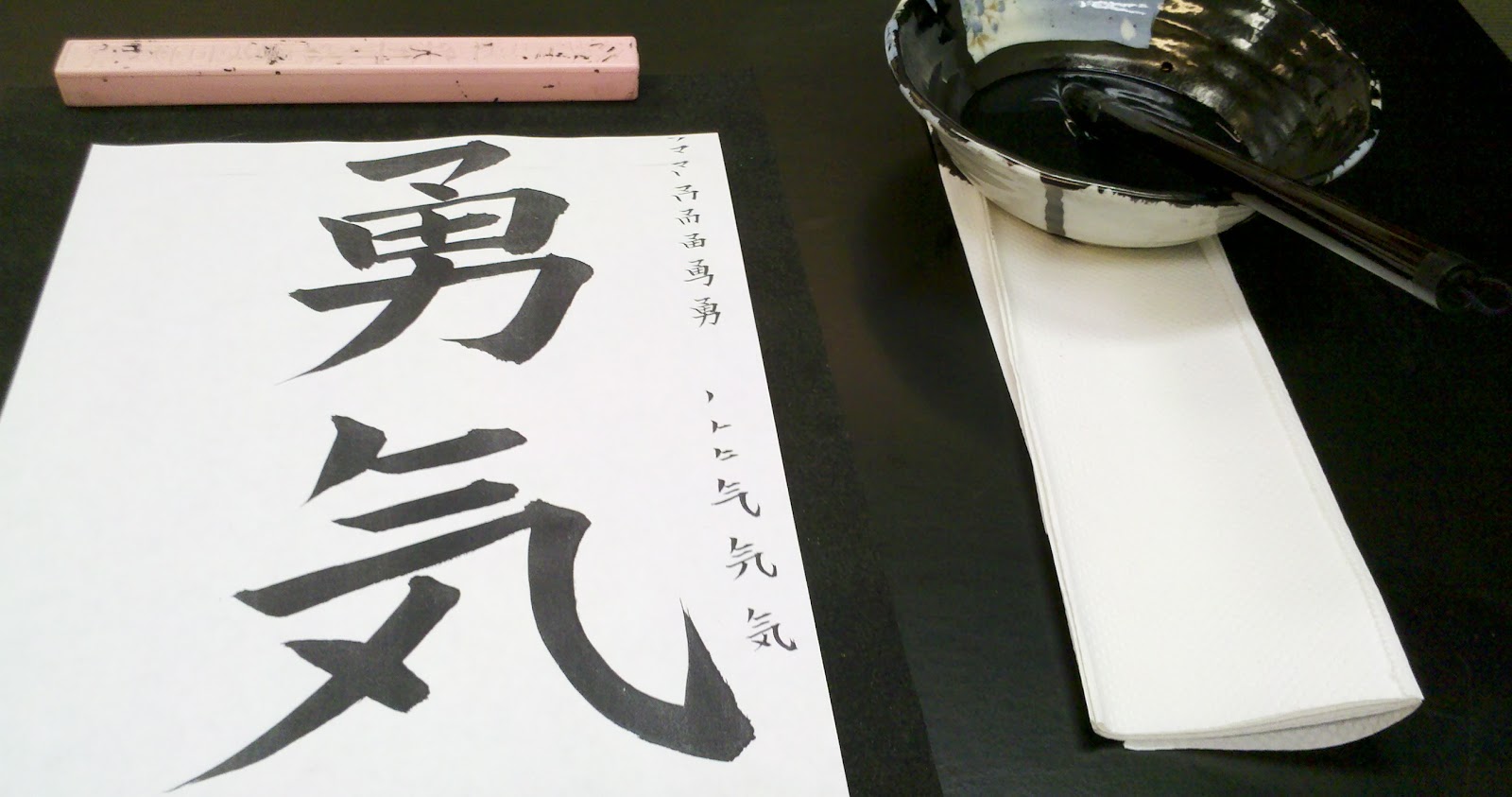
Obviously I spent a lot of time in the gallery, but I will say that the most enjoyable time I spent was in the 20 minute calligraphy workshop. Attendees were taught basic principles and then given an opportunity to copy kanji characters with a calligraphy brush and black ink (see right). It was great fun and I left feeling like I might want to take future courses at the Japan Society. The instructor and helpers were very encouraging.
I also stopped by the origami workshop, which was casual and very approachable. They had several instructors from the organization Origami USA (www.origami-usa.org) who were all patient and clearly wanted to share their love of origami. They walked participants through step by step instructions on folding cranes, swans, flowers, cubes, etc. and also had a display of some very intricate origami examples (see left).
Finally, I also enjoyed a couple of concert sessions in the remarkably well-appointed auditorium. I particularly enjoyed the xylophonist (the "Flight of the Bumble Bee" was perfect and dramatic) and the traditional wind instrument player. The more modern pieces by the pianist and the singer were not to my taste (see my blog about the NY Philharmonic) but for all of this included in the entrance fee, I thought this was the bargain of the month.
By the way, the Japan Society also rents out space for private events and their lovely, zen-like interiors could be just the right thing. If you are in the UN neighborhood, I think their normal art exhibit would be worth a look. And if you have any interest in learning Japanese (or if you are Japanese and have an interest in learning English), this seems like a great place to take classes. All in all, this is a good resource for all things Japanese in NYC.